 Add to Chrome
 Add to Firefox
 Add to Edge
MolRecBench-Wild: A Real-World Benchmark for Optical Chemical Structure Recognition
May 07, 2026
Optical Chemical Structure Recognition (OCSR) aims to translate molecular diagrams in scientific literature into machine-readable formats, but current systems remain unreliable on real-world images due to substantial visual and chemical complexity. We introduce MOSAIC, a dual-dimensional difficulty framework with 37 fine-grained labels that jointly characterize visual interference and chemical semantic challenges in molecular diagrams. Based on this framework, we construct MolRecBench-Wild, a benchmark of 5,029 structures from 820 recent chemistry papers, covering the full difficulty spectrum observed in real publications. To enable faithful semantic evaluation beyond SMILES and MolFile, we propose CARBON, a representation language capable of expressing valence variations, icon-based groups, and other non-standard chemical semantics. We further adopt a dual-track evaluation protocol supporting both CARBON and SMILES outputs for broad model compatibility. Comprehensive experiments over 18 OCSR-capable models reveal severe performance degradation on MolRecBench-Wild, exposing a large gap between previous patent benchmarks and real-world academic scenarios.

CoCo-SAM3: Harnessing Concept Conflict in Open-Vocabulary Semantic Segmentation
Apr 21, 2026SAM3 advances open-vocabulary semantic segmentation by introducing a prompt-driven mask generation paradigm. However, in multi-class open-vocabulary scenarios, masks generated independently from different category prompts lack a unified and inter-class comparable evidence scale, often resulting in overlapping coverage and unstable competition. Moreover, synonymous expressions of the same concept tend to activate inconsistent semantic and spatial evidence, leading to intra-class drift that exacerbates inter-class conflicts and compromises overall inference stability. To address these issues, we propose CoCo-SAM3 (Concept-Conflict SAM3), which explicitly decouples inference into intra-class enhancement and inter-class competition. Our method first aligns and aggregates evidence from synonymous prompts to strengthen concept consistency. It then performs inter-class competition on a unified comparable scale, enabling direct pixel-wise comparisons among all candidate classes. This mechanism stabilizes multi-class inference and effectively mitigates inter-class conflicts. Without requiring any additional training, CoCo-SAM3 achieves consistent improvements across eight open-vocabulary semantic segmentation benchmarks.
TransSplat: Unbalanced Semantic Transport for Language-Driven 3DGS Editing
Apr 21, 2026Language-driven 3D Gaussian Splatting (3DGS) editing provides a more convenient approach for modifying complex scenes in VR/AR. Standard pipelines typically adopt a two-stage strategy: first editing multiple 2D views, and then optimizing the 3D representation to match these edited observations. Existing methods mainly improve view consistency through multi-view feature fusion, attention filtering, or iterative recalibration. However, they fail to explicitly address a more fundamental issue: the semantic correspondence between edited 2D evidence and 3D Gaussians. To tackle this problem, we propose TransSplat, which formulates language-driven 3DGS editing as a multi-view unbalanced semantic transport problem. Specifically, our method establishes correspondences between visible Gaussians and view-specific editing prototypes, thereby explicitly characterizing the semantic relationship between edited 2D evidence and 3D Gaussians. It further recovers a cross-view shared canonical 3D edit field to guide unified 3D appearance updates. In addition, we use transport residuals to suppress erroneous edits in non-target regions, mitigating edit leakage and improving local control precision. Qualitative and quantitative results show that, compared with existing 3D editing methods centered on enhancing view consistency, TransSplat achieves superior performance in local editing accuracy and structural consistency.
ChordEdit: One-Step Low-Energy Transport for Image Editing
Feb 22, 2026The advent of one-step text-to-image (T2I) models offers unprecedented synthesis speed. However, their application to text-guided image editing remains severely hampered, as forcing existing training-free editors into a single inference step fails. This failure manifests as severe object distortion and a critical loss of consistency in non-edited regions, resulting from the high-energy, erratic trajectories produced by naive vector arithmetic on the models' structured fields. To address this problem, we introduce ChordEdit, a model agnostic, training-free, and inversion-free method that facilitates high-fidelity one-step editing. We recast editing as a transport problem between the source and target distributions defined by the source and target text prompts. Leveraging dynamic optimal transport theory, we derive a principled, low-energy control strategy. This strategy yields a smoothed, variance-reduced editing field that is inherently stable, facilitating the field to be traversed in a single, large integration step. A theoretically grounded and experimentally validated approach allows ChordEdit to deliver fast, lightweight and precise edits, finally achieving true real-time editing on these challenging models.
Riemannian Liquid Spatio-Temporal Graph Network
Jan 20, 2026Liquid Time-Constant networks (LTCs), a type of continuous-time graph neural network, excel at modeling irregularly-sampled dynamics but are fundamentally confined to Euclidean space. This limitation introduces significant geometric distortion when representing real-world graphs with inherent non-Euclidean structures (e.g., hierarchies and cycles), degrading representation quality. To overcome this limitation, we introduce the Riemannian Liquid Spatio-Temporal Graph Network (RLSTG), a framework that unifies continuous-time liquid dynamics with the geometric inductive biases of Riemannian manifolds. RLSTG models graph evolution through an Ordinary Differential Equation (ODE) formulated directly on a curved manifold, enabling it to faithfully capture the intrinsic geometry of both structurally static and dynamic spatio-temporal graphs. Moreover, we provide rigorous theoretical guarantees for RLSTG, extending stability theorems of LTCs to the Riemannian domain and quantifying its expressive power via state trajectory analysis. Extensive experiments on real-world benchmarks demonstrate that, by combining advanced temporal dynamics with a Riemannian spatial representation, RLSTG achieves superior performance on graphs with complex structures. Project Page: https://rlstg.github.io
MMErroR: A Benchmark for Erroneous Reasoning in Vision-Language Models
Jan 06, 2026Recent advances in Vision-Language Models (VLMs) have improved performance in multi-modal learning, raising the question of whether these models truly understand the content they process. Crucially, can VLMs detect when a reasoning process is wrong and identify its error type? To answer this, we present MMErroR, a multi-modal benchmark of 2,013 samples, each embedding a single coherent reasoning error. These samples span 24 subdomains across six top-level domains, ensuring broad coverage and taxonomic richness. Unlike existing benchmarks that focus on answer correctness, MMErroR targets a process-level, error-centric evaluation that requires models to detect incorrect reasoning and classify the error type within both visual and linguistic contexts. We evaluate 20 advanced VLMs, even the best model (Gemini-3.0-Pro) classifies the error in only 66.47\% of cases, underscoring the challenge of identifying erroneous reasoning. Furthermore, the ability to accurately identify errors offers valuable insights into the capabilities of multi-modal reasoning models. Project Page: https://mmerror-benchmark.github.io
VPTracker: Global Vision-Language Tracking via Visual Prompt and MLLM
Dec 28, 2025Vision-Language Tracking aims to continuously localize objects described by a visual template and a language description. Existing methods, however, are typically limited to local search, making them prone to failures under viewpoint changes, occlusions, and rapid target movements. In this work, we introduce the first global tracking framework based on Multimodal Large Language Models (VPTracker), exploiting their powerful semantic reasoning to locate targets across the entire image space. While global search improves robustness and reduces drift, it also introduces distractions from visually or semantically similar objects. To address this, we propose a location-aware visual prompting mechanism that incorporates spatial priors into the MLLM. Specifically, we construct a region-level prompt based on the target's previous location, enabling the model to prioritize region-level recognition and resort to global inference only when necessary. This design retains the advantages of global tracking while effectively suppressing interference from distracting visual content. Extensive experiments show that our approach significantly enhances tracking stability and target disambiguation under challenging scenarios, opening a new avenue for integrating MLLMs into visual tracking. Code is available at https://github.com/jcwang0602/VPTracker.
PR-CapsNet: Pseudo-Riemannian Capsule Network with Adaptive Curvature Routing for Graph Learning
Dec 09, 2025Capsule Networks (CapsNets) show exceptional graph representation capacity via dynamic routing and vectorized hierarchical representations, but they model the complex geometries of real\-world graphs poorly by fixed\-curvature space due to the inherent geodesical disconnectedness issues, leading to suboptimal performance. Recent works find that non\-Euclidean pseudo\-Riemannian manifolds provide specific inductive biases for embedding graph data, but how to leverage them to improve CapsNets is still underexplored. Here, we extend the Euclidean capsule routing into geodesically disconnected pseudo\-Riemannian manifolds and derive a Pseudo\-Riemannian Capsule Network (PR\-CapsNet), which models data in pseudo\-Riemannian manifolds of adaptive curvature, for graph representation learning. Specifically, PR\-CapsNet enhances the CapsNet with Adaptive Pseudo\-Riemannian Tangent Space Routing by utilizing pseudo\-Riemannian geometry. Unlike single\-curvature or subspace\-partitioning methods, PR\-CapsNet concurrently models hierarchical and cluster or cyclic graph structures via its versatile pseudo\-Riemannian metric. It first deploys Pseudo\-Riemannian Tangent Space Routing to decompose capsule states into spherical\-temporal and Euclidean\-spatial subspaces with diffeomorphic transformations. Then, an Adaptive Curvature Routing is developed to adaptively fuse features from different curvature spaces for complex graphs via a learnable curvature tensor with geometric attention from local manifold properties. Finally, a geometric properties\-preserved Pseudo\-Riemannian Capsule Classifier is developed to project capsule embeddings to tangent spaces and use curvature\-weighted softmax for classification. Extensive experiments on node and graph classification benchmarks show PR\-CapsNet outperforms SOTA models, validating PR\-CapsNet's strong representation power for complex graph structures.
Unlocking the Potential of MLLMs in Referring Expression Segmentation via a Light-weight Mask Decode
Aug 06, 2025Reference Expression Segmentation (RES) aims to segment image regions specified by referring expressions and has become popular with the rise of multimodal large models (MLLMs). While MLLMs excel in semantic understanding, their token-generation paradigm struggles with pixel-level dense prediction. Existing RES methods either couple MLLMs with the parameter-heavy Segment Anything Model (SAM) with 632M network parameters or adopt SAM-free lightweight pipelines that sacrifice accuracy. To address the trade-off between performance and cost, we specifically propose MLLMSeg, a novel framework that fully exploits the inherent visual detail features encoded in the MLLM vision encoder without introducing an extra visual encoder. Besides, we propose a detail-enhanced and semantic-consistent feature fusion module (DSFF) that fully integrates the detail-related visual feature with the semantic-related feature output by the large language model (LLM) of MLLM. Finally, we establish a light-weight mask decoder with only 34M network parameters that optimally leverages detailed spatial features from the visual encoder and semantic features from the LLM to achieve precise mask prediction. Extensive experiments demonstrate that our method generally surpasses both SAM-based and SAM-free competitors, striking a better balance between performance and cost. Code is available at https://github.com/jcwang0602/MLLMSeg.
GTR-CoT: Graph Traversal as Visual Chain of Thought for Molecular Structure Recognition
Jun 09, 2025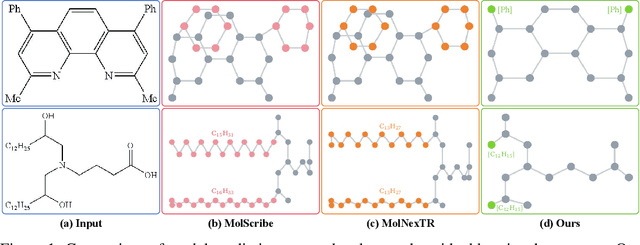
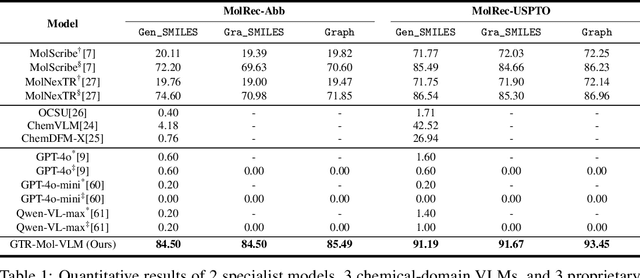
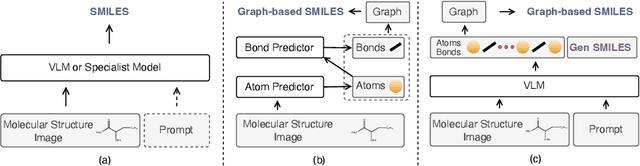
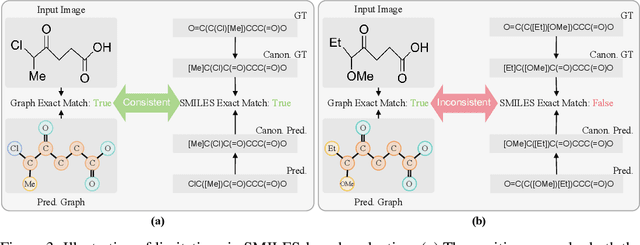
Optical Chemical Structure Recognition (OCSR) is crucial for digitizing chemical knowledge by converting molecular images into machine-readable formats. While recent vision-language models (VLMs) have shown potential in this task, their image-captioning approach often struggles with complex molecular structures and inconsistent annotations. To overcome these challenges, we introduce GTR-Mol-VLM, a novel framework featuring two key innovations: (1) the \textit{Graph Traversal as Visual Chain of Thought} mechanism that emulates human reasoning by incrementally parsing molecular graphs through sequential atom-bond predictions, and (2) the data-centric principle of \textit{Faithfully Recognize What You've Seen}, which addresses the mismatch between abbreviated structures in images and their expanded annotations. To support model development, we constructed GTR-CoT-1.3M, a large-scale instruction-tuning dataset with meticulously corrected annotations, and introduced MolRec-Bench, the first benchmark designed for a fine-grained evaluation of graph-parsing accuracy in OCSR. Comprehensive experiments demonstrate that GTR-Mol-VLM achieves superior results compared to specialist models, chemistry-domain VLMs, and commercial general-purpose VLMs. Notably, in scenarios involving molecular images with functional group abbreviations, GTR-Mol-VLM outperforms the second-best baseline by approximately 14 percentage points, both in SMILES-based and graph-based metrics. We hope that this work will drive OCSR technology to more effectively meet real-world needs, thereby advancing the fields of cheminformatics and AI for Science. We will release GTR-CoT at https://github.com/opendatalab/GTR-CoT.